Anton Emmanuel et al., Neurogastroenterology & Motility, 2025
Transanal irrigation (TAI) is a well-established, minimally invasive treatment for constipation and fecal incontinence. Over the last two decades, its use has expanded far beyond specialist neurogenic bowel clinics to include patients with functional and post-surgical bowel dysfunction as well.
With this growing use comes a clear need for updated guidance on how to initiate, monitor, and optimize transanal irrigation safely, particularly as newer low-volume systems become more widely available. In this international consensus paper, Emmanuel et al. review the current literature and expert clinical experience to provide updated recommendations on patient selection, contraindications, training, and follow-up, with the goal of improving long-term adherence and safety.
Bowel Dysfunction and the Role of Transanal Irrigation
Chronic bowel dysfunction—including constipation and fecal incontinence—affects a wide range of patients with neurogenic conditions (such as spinal cord injury, spina bifida, and multiple sclerosis), as well as those with non-neurogenic causes such as slow-transit constipation, obstructed defecation, and bowel symptoms following colorectal surgery.
When conservative measures (dietary changes, fluid intake, scheduled toileting, and
laxatives) fail, transanal irrigation is often introduced as a next-step therapy, helping
patients establish a predictable bowel routine, reduce accidents, and improve quality of life. The primary goal of bowel management is to optimize continence, prevent constipation, maintain skin integrity, and support independence.
How Transanal Irrigation Works
Transanal irrigation involves the introduction of water into the rectum—and in some cases the distal colon—via the anus to stimulate peristalsis and evacuate stool.
The paper highlights an important distinction between:
- Low-volume TAI (generally <175 mL), which primarily clears the rectum and sigmoid
colon. - High-volume TAI (>175 mL), which reaches further into the colon and has broader
effects.
Both approaches can be effective, but they differ in safety profile, indications, and contraindications, making appropriate patient selection and training essential.
Is Transanal Irrigation Safe?
A key focus of the consensus is safety. Based on a review of 27 clinical studies involving over1,400 patients, serious adverse events associated with TAI are rare. Minor side effects—such as abdominal cramping, bloating, fluid leakage, or mild rectal discomfort—are relatively common but typically transient.
The most serious potential complication is bowel perforation, which is estimated to occur in approximately 1 in 500,000 irrigations. Importantly, perforation is most likely to occur during the initiation phase, underscoring the importance of proper training, gradual volume escalation, and specialist supervision when starting therapy.
Updated Contraindications for Transanal Irrigation
One of the most significant contributions of this paper is an updated and refined list of contraindications and precautions for TAI, reflecting over 15 years of accumulated clinical experience.
Rather than treating transanal irrigation as a single therapy, the authors differentiate
contraindications based on:
- Irrigation volume (low vs high volume)
- Device type (balloon catheter vs cone)
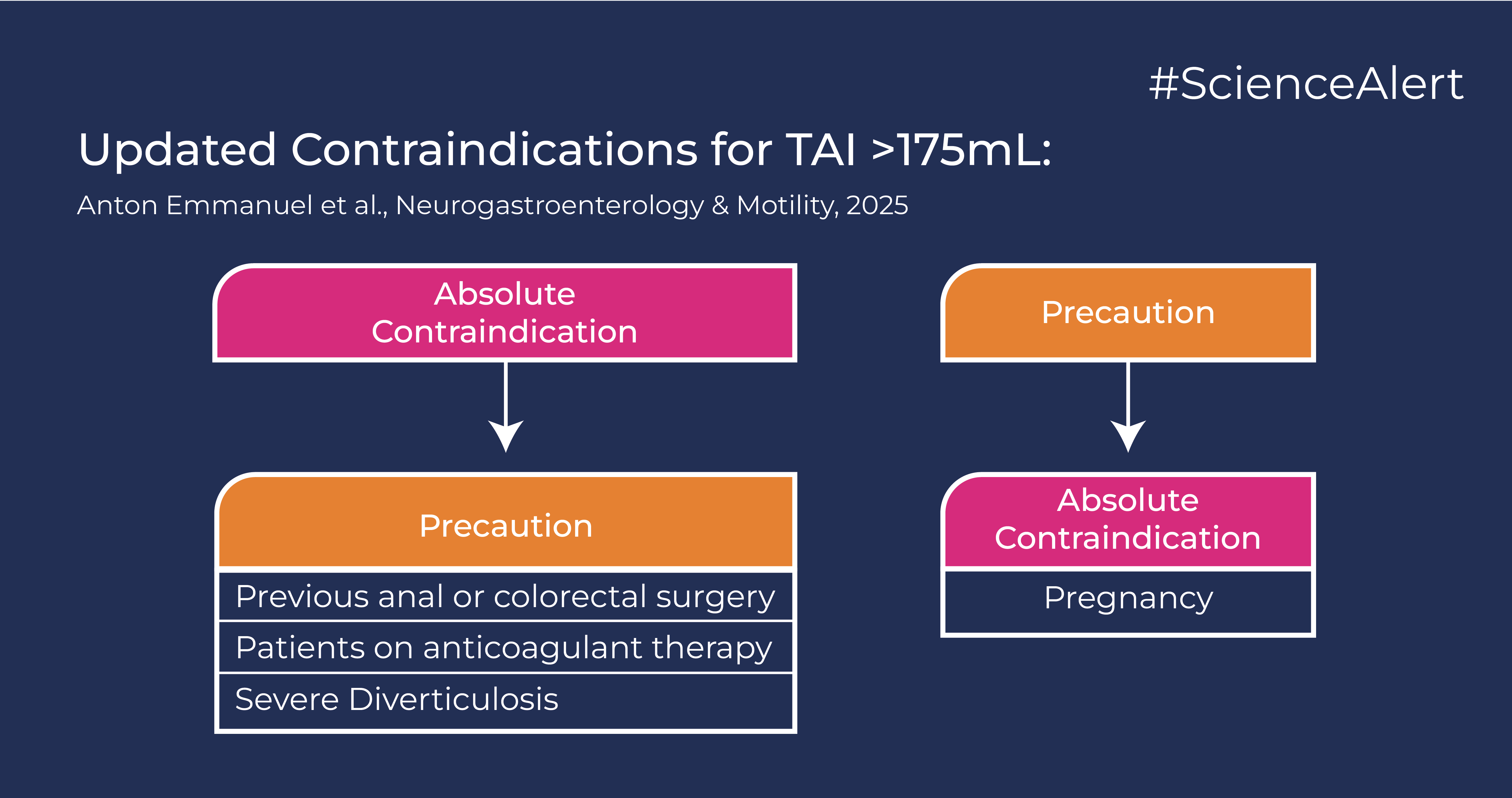
Several conditions previously considered absolute contraindications—such as diverticular disease or anticoagulant use—have now been downgraded to precautions. This reflects growing evidence that, with careful technique and monitoring, TAI can be safely used in a broader patient population.
The status around pregnancy hass been a debated topic and has now been upgraded to a contraindication for high-volume TAI. If a pregnant patient still wishes to use TAI, it is now proposed that they may be switched to low-volume TAI during pregnancy instead.
The Importance of Proper Training When Starting TAI
The consensus strongly emphasizes that training is the single most important factor in ensuring both safety and long-term success with transanal irrigation.
Key recommendations include:
- Face-to-face training whenever possible
- Clear instruction on catheter or cone insertion, balloon inflation, and water volume
- Education on expected side effects and troubleshooting common technical issues
- Obtaining informed consent after discussing risks and benefits
Even when in-person irrigation cannot be demonstrated, device handling and technique should be carefully reviewed with time allocated for patient questions.
Improving Long-Term Adherence to Transanal Irrigation
Discontinuation remains a challenge with TAI, particularly during the early phase of
treatment. The authors describe several forms of non-adherence, including early dropout and inconsistent use, and highlight strategies to address these issues.
A structured follow-up program is strongly recommended, including:
- Regular phone contact during initiation (every 2 weeks)
- Face-to-face review after 6–8 weeks
- Ongoing annual follow-up once treatment is stable
The paper also emphasizes reviewing concurrent laxative use, as many patients can reduce or discontinue laxatives once TAI is established. Specialist nurse support and consistent access to professional advice were identified as key factors in sustaining adherence.

Low-Volume vs High-Volume TAI: Choosing the Right Approach
Low-volume transanal irrigation is increasingly used, particularly for patients with fecal incontinence. To date, there have been no reported cases of bowel perforation associated with low-volume irrigation, making it an especially attractive option for selected patients.
High-volume irrigation remains appropriate for patients with severe constipation or
combined symptoms but requires greater attention to contraindications, technique, and gradual titration of volume.
The consensus reinforces that there is no single “correct” TAI regimen—therapy should always be individualized based on symptoms, underlying condition, functional ability, and patient preference.
Key Takeaways From the Emmanuel et al. Consensus
his international consensus confirms that transanal irrigation is a safe, effective, and
increasingly versatile therapy for bowel dysfunction when introduced correctly. The paper highlights that:
- Serious complications are rare, particularly with appropriate training
- Updated contraindications allow for safer use across a wider patient population
- Low-volume TAI offers an excellent safety profile for selected patients
- Structured training and follow-up are essential to optimize adherence and outcomes
Overall, the study reinforces that careful patient selection, individualized training, and
ongoing professional support are the cornerstones of successful transanal irrigation therapy in modern bowel management.